

The Problem
A knee never goes all at once.
It starts as something you can ignore. A twinge on the stairs — going down, not up. Ten stiff minutes before the first coffee. A dull ache on the evening the weather turns.
So you adjust. You take the lift. You stop running on pavement. You stand up more carefully than you did a year ago. None of it feels like a decision at the time, and that is exactly the problem: by the time a knee has your attention, you have already spent months quietly working around it.
Most people don’t need a treatment. They need a daily habit.
You are not an outlier. Osteoarthritis affects about 15 % of everyone over 30 — some 595 million people worldwide — and the knee is the joint it reaches first and most often. (Lancet Rheumatology, 2023)

Made For
Who reaches for it
These are the six reasons people tell us they bought one. We have listed them as situations, not as promises.
01
Osteoarthritis
The wear-and-tear kind, in the knee. It is the single most common reason people buy a device like this — usually alongside the exercise and the weight advice a doctor has already given them, not instead of it.
02
Runner’s knee
The ache around and under the kneecap that shows up the day after the mileage. Warmth before you move and massage after is the routine most runners settle into.
03
After a repair — once you’re cleared
Meniscus, ligament, fracture. Heat and massage come late in that process, and only when your surgeon or physiotherapist says so. Never on a fresh repair, and never over hardware without asking first.
04
Morning stiffness
The first ten minutes out of bed, before the joint agrees to bend. A session of warmth does what pacing around the kitchen does, without the pacing.
05
Cold, damp weather
The knee that tightens from October onwards. Warm tissue lets go; cold tissue braces. This is the least complicated thing on the list and the one people notice first.
06
Long days upright
Nurses, teachers, trades, anyone whose job is standing. Not an injury — just a joint that has been loaded for nine hours and would like some circulation back.
Three Mechanisms
One shell, three things a knee responds to
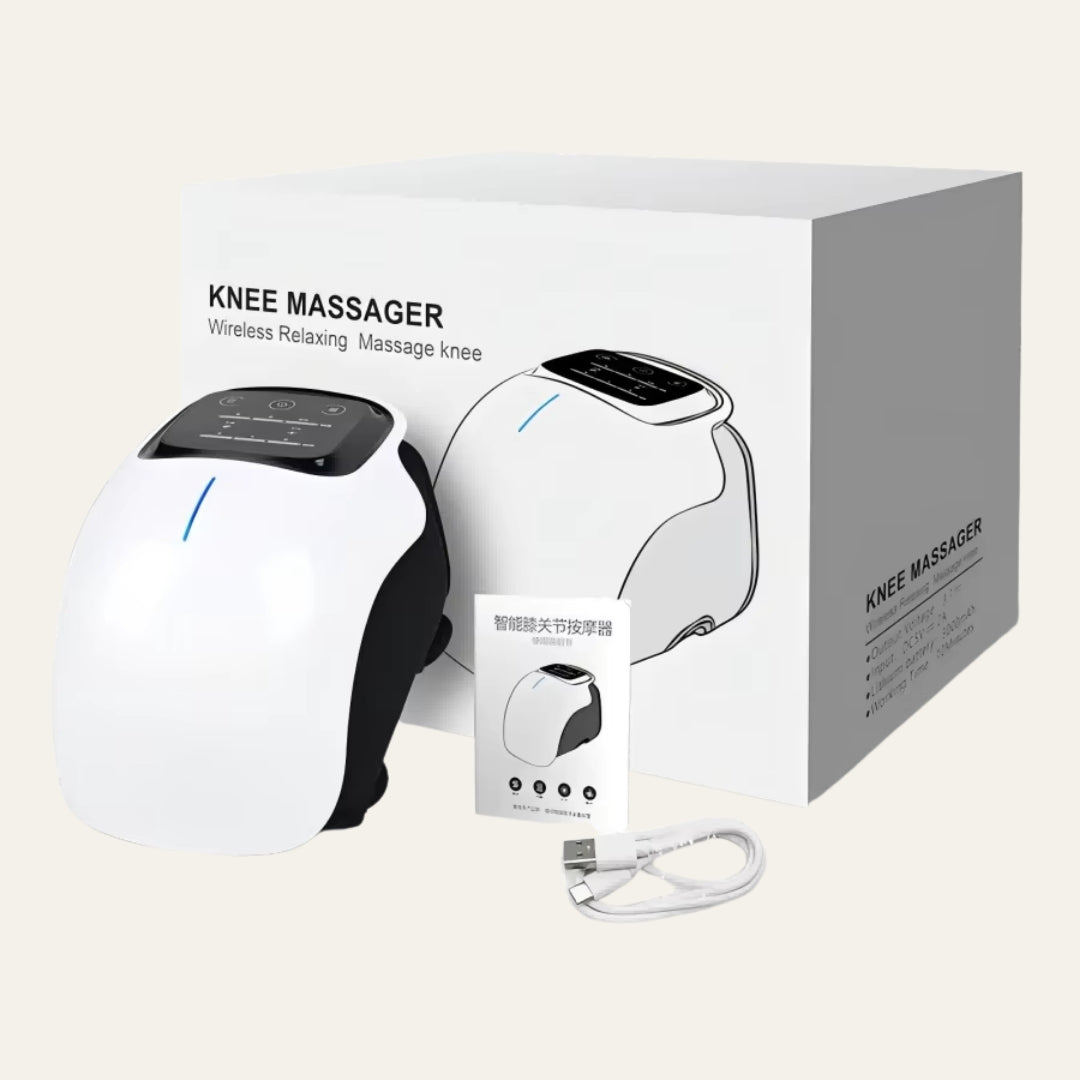
Three buttons on the lid, no menus and no app. Tap through the mechanisms below.
Warmth that holds, instead of a pack that cools
A carbon-fibre element warms the joint across three levels, from about 45 °C to 55 °C. Warmth is the oldest tool there is for a stiff joint, and the physiology is unambiguous: every 1 °C of tissue temperature raises local metabolism by 10–15 %, widens blood flow and lowers the viscosity of the fascia around the joint. The 2019 ACR/Arthritis Foundation osteoarthritis guideline lists thermal treatment among its recommended options for the knee. Unlike a grain pillow, the temperature is held for the whole session rather than fading after three minutes.
- Three levels — about 45 °C, 50 °C, 55 °C
- Carbon-fibre element, even across the joint
- Thermal treatment is in the 2019 ACR/AF knee-OA guideline
Three massage modes, on their own button
A ring of motors works the tissue around the kneecap while the warmth is already in it. Low for the first week, High after a long day on your feet, and Auto when you would rather not think about it — Auto cycles the intensity for you from start to finish. In a randomised trial of 125 knee-osteoarthritis patients, a weekly hour of massage moved the WOMAC pain-and-function score by 24 points in eight weeks; usual care moved it by 6.3.
- Auto, Low and High — one short press to step through
- Runs with the heat or on its own
- 125-patient randomised trial — PLOS ONE, 2012
Red light at 615–650 nm, on its own key
A ring of red LEDs sits in the lining, so the light lands on the skin over the joint rather than on a trouser leg. It has its own button — one press on, one press off — so you can run it with the heat, with the massage, or by itself.
We are going to be straight with you about this one: the light-therapy trials that moved knee pain used near-infrared wavelengths, not the red band. Read the evidence section below before you buy this for the light alone.
- 615–650 nm, switched independently
- A full ring of LEDs around the massage zone, not a handful of diodes
- For light at joint depth, see the AuraPanel (660 + 850 nm)
The Evidence
What the research actually shows
Warmth and massage have each been tested against placebo or usual care in people with knee osteoarthritis. Here are the numbers and the papers — and, below them, the honest version of the red-light story.
Applied warmth
10–15 %
more local metabolism per +1 °C of tissue
Warmth is not a comfort measure. Raising tissue temperature widens blood flow, lowers the viscosity of the fascia around the joint and dampens pain signalling at the spinal cord. The 2019 ACR/Arthritis Foundation guideline includes thermal treatment among its recommended options for knee osteoarthritis, for improvements lasting up to a year.
Rossi R. Heat therapy for different knee diseases. Front Rehabil Sci 2024;5:1390416 · Kolasinski SL et al. 2019 ACR/AF Guideline. Arthritis Rheumatol 2020;72:220–33. doi.org
Massage
−24.0
WOMAC points in 8 weeks (usual care: −6.3)
In a randomised dose-finding trial, 125 people with knee osteoarthritis were assigned different massage doses or usual care. The weekly-hour group improved its WOMAC pain-stiffness-function score by 24 points in eight weeks — close to four times the change in the usual-care group.
Perlman AI et al. Massage therapy for osteoarthritis of the knee: a randomized dose-finding trial. PLOS ONE 2012;7(2):e30248. doi.org
About the red light
The part most brands quietly get wrong
You will find knee wraps advertised with impressive light-therapy statistics. Those numbers are real — a 2019 meta-analysis of 22 randomised placebo-controlled trials found light therapy beat placebo by 14.2 mm on a 100 mm pain scale in knee osteoarthritis — but they come from near-infrared wavelengths, 785–860 nm and 904–905 nm. A 2025 review of the field puts it bluntly: for knee osteoarthritis, 808 nm may be superior to 660 nm.
The AuraKnee Pro emits 615–650 nm. That is the red band, not the near-infrared one, and red light does not reach as deep into tissue. So we are not going to put those numbers on this page and hope you don’t check. The red light here is a pleasant extra on top of the two mechanisms that are doing the work — the warmth and the massage.
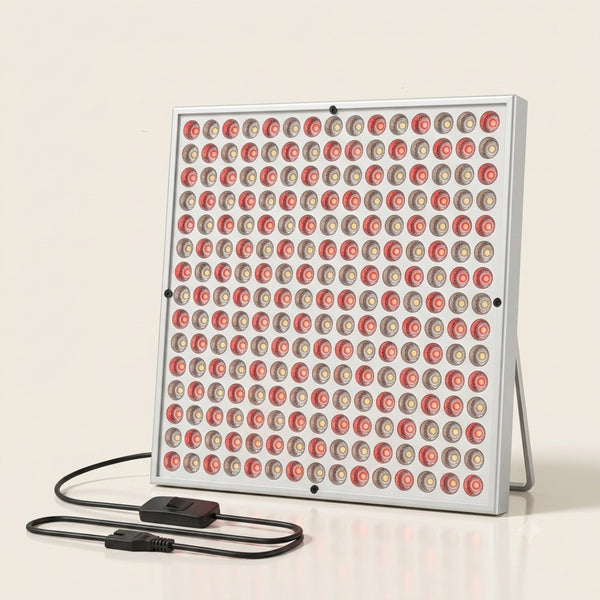
If light at joint depth is what you are after, that is a different device: our AuraPanel runs 660 nm red together with 850 nm near-infrared.
Stausholm MB et al. BMJ Open 2019;9:e031142 · Hennessy SN, Corcoran GD. Low-level laser therapy in osteoarthritic pain. Osteoarthr Cartil Open 2025;100685.
And the line we won’t cross. These trials tested the methods, with clinical equipment and supervised protocols, not this device. The AuraKnee Pro is a wellness device, not a medical one: it does not diagnose, treat or cure osteoarthritis, and it does not replace your doctor or your physiotherapist. If your knee is swollen, locking, giving way or painful at rest, see one.
Once or twice a day
Warmth, massage and red light in one shell — CHF 109.00
Side By Side
AuraKnee Pro vs. the bare-shell type
Turn two knee massagers over. The difference is on the side that touches you.

AuraKnee Pro

Others
The right-hand column describes the units we handled while sourcing this one. Specifications vary by brand — check any device you compare against, including ours.
Take the AuraKnee Pro — CHF 109.00
The Interface
Three buttons. That is the entire interface.
No app, no pairing, no menu. Hold the middle button for two seconds and it starts where most people want it: automatic massage, low heat, red light on. Everything after that is one tap.
- Left button steps the massage: Auto → Low → High → off
- Right button steps the heat: Low → Medium → High → off
- The red-light key toggles the light on and off on its own
- A short beep confirms every press — useful when the panel is out of sight on your knee
- Large, lit symbols on an LED touch screen, readable without glasses

The Ritual
Strap it on. Then it stops by itself.
Strap it on
Sit down, place the shell over the kneecap and pull the Velcro strap snug. It should sit firm, not tight.
Hold to start
Long-press the power key. It begins in automatic massage, low heat, red light on.
Dial it in
Step the heat up if the room is cold, drop the massage to Low if it is your first week. Then leave it alone.
Let it finish
The built-in timer ends the session for you. Once or twice a day is a normal routine — one knee at a time.
When To Use It
Four slots that fit a real day
| Moment | Setting | Why |
|---|---|---|
| First thing | Medium heat, Auto | Shortens the stiff stretch before the knee loosens on its own |
| Desk break | Low heat, Low | A session at the desk instead of standing up carefully at 6 pm |
| After activity | High heat, High | For the evening after a run, a hike or a long day upright |
| Cold evenings | High heat, Auto | The setting most people reach for from October onwards |
One or two sessions a day, one knee at a time. Consistency beats intensity.
The Maths
What a knee routine usually costs
One payment, no refills, no appointments to keep. Two months of weekly massage costs more than the device does — and the device is still on your shelf in year three.
Add to cart — CHF 109.00
30-Day Trial
Thirty days. One knee. One session a day.
Give it a month of daily sessions. If your knee doesn’t feel looser in the mornings and easier on the stairs, send it back for a full refund.
- AuraKnee Pro, USB-C cable and manual
- 3 heat levels to 55 °C · 3 massage modes · 615–650 nm red light
- Free shipping, dispatched within 24 hours
- 30-day money-back guarantee — you pay nothing to try it
Two of them: CHF 153.10 instead of CHF 218.00 — one knee each.

Complete Your Ritual